Risks of High Leverage Forex Trading: Margin Calls, Martingale and Risk Management
Learn the risks of high leverage forex trading, including margin calls, slippage, spread costs, Martingale losses, copy trading and practical risk management.
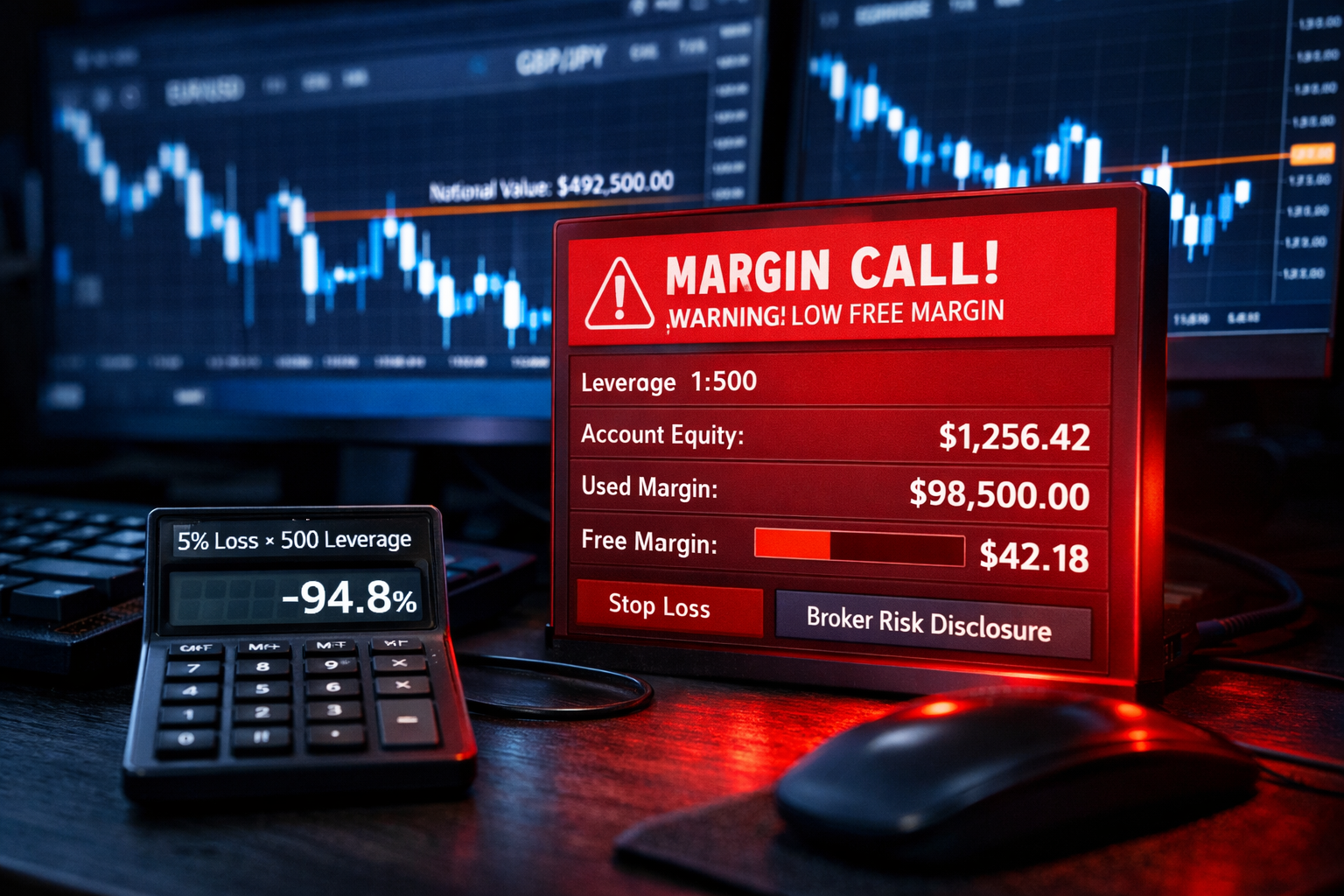
A $1,000 forex account controlling $100,000 at 100:1 leverage has only a 1% price move between the account’s starting value and a $1,000 gross loss. That simple calculation explains why the risks of high leverage forex trading reach far beyond choosing the right currency pair.
High leverage doesn’t increase your probability of profit. It increases the size of every result, including spread costs, slippage, margin pressure, and emotional decisions. You need a position-size plan that uses only a small part of your available buying power.
## Why Leverage Turns a Small Move Into a Large Account Problem
Leverage lets you control a larger notional value with less cash. If your broker offers 100:1 leverage, $1,000 of margin can support a position worth $100,000. A 0.50% move against that position creates a $500 loss before trading costs, which equals half of the account in this example.
The broker’s maximum leverage is a limit, not a target. **Available leverage is not a sensible position size.** A trader with 30:1 leverage can still take a position that is too large, while a trader with 100:1 leverage can trade a smaller position and keep more unused margin.
For a detailed breakdown of the 1-2-4-8 system, cumulative losses and position sizing, see our guide to the{' '} Martingale Forex Strategy: 1-2-4-8 Risk Management .
> Margin is the money set aside to support an open position; it is not a deposit against a guaranteed loss. Your used margin rises as your position grows. Your free margin is what remains available for losses and new trades. When losses reduce your equity, the account’s margin level falls even if the currency pair has not moved far in percentage terms. Consider a $2,000 account trading a $40,000 position. A 1% adverse move produces a $400 gross loss, or 20% of the account. Add a 2-pip spread, a commission, and an overnight financing charge, and the position starts farther behind before the market makes its next move. The behavioral risk is just as serious. A trader who sees a $400 loss may widen a stop, add another position, or switch pairs to recover quickly. That response changes a planned trade into an emergency, and high leverage gives the emergency more financial force. ## Margin Calls and Forced Liquidation Happen Before You Expect A margin call occurs when your equity falls close to the amount required to support open trades. Forced liquidation follows when the broker’s rules trigger automatic position closures. The exact thresholds differ by broker, account type, and jurisdiction, so you must read the margin policy before funding an account. ### The Margin-Level Calculation Suppose an account has $1,500 in equity and uses $750 of margin. Its margin level is 200%. If open losses reduce equity to $900 while used margin stays at $750, the margin level falls to 120%. A further loss can move the account toward the broker’s warning or liquidation threshold. This calculation changes quickly during fast markets. A position that looks safe at 200% margin level can approach a call after a sharp move, a spread expansion, or several trades losing together. **Monitor equity and free margin, not only the chart.** ### Why Liquidation Prices Are Not Fixed Forced liquidation does not always happen at the price shown when you open a trade. Brokers close positions using available market prices, and those prices can change while orders are being processed. If several trades are open, the broker’s liquidation sequence can also affect which position closes first. A stop-loss order has the same limitation. It defines an exit instruction, not a guaranteed execution price. During a weekend gap, a major economic release, or a sudden liquidity drop, the next available price can be materially worse than your stop. ### The Gap From Warning to Closure Assume a broker issues a margin warning at 100% and begins liquidation at 50%. An account at 110% has little room for error, even though it has not technically reached the call level. On a $10,000 account with $8,000 in used margin, only $2,000 of equity remains above the required margin amount. A broker may close positions without waiting for your response once the liquidation condition is reached. You cannot assume that adding funds will arrive in time, especially when a bank transfer or card review takes hours rather than seconds. Keep a cash reserve outside the trading account and avoid using the broker’s maximum exposure. ## Volatility, Gaps, and Trading Costs Defeat Perfect-Looking Plans Currency prices do not move in a clean line. A major central-bank announcement, employment report, election result, or unexpected geopolitical event can produce a rapid move while available liquidity changes. Leverage makes that operational problem larger because each pip affects more dollars. ### Spreads Widen When Liquidity Thins The spread is the difference between the bid and ask price. A major pair might show a narrow spread during active U.S. market hours, then display a wider spread around a rollover period or major announcement. If your position is large, that temporary widening can consume a meaningful part of your free margin. For example, a 2-pip spread on a small position may be a minor entry cost. On a position where each pip equals $20, the same 2 pips cost $40 before the trade moves. A spread expansion to 10 pips would create a $200 mark-to-market disadvantage. ### Slippage Changes the Exit Slippage is the difference between your requested order price and the executed price. It affects market orders and may affect stop orders when the market moves faster than available quotes. **A stop limits your planned risk; it does not guarantee an exact dollar loss.** A stop set 25 pips away might normally risk $250 when each pip is worth $10. If a gap produces 38 pips of slippage, the gross loss becomes about $630 instead. That is a practical reason to reduce position size before known event risk, not a reason to remove the stop. ### Financing Keeps Working After the Chart Goes Quiet Overnight financing, also called a swap or rollover charge, applies when a position remains open across the broker’s daily cutoff. The charge depends on the pair, direction, position size, and broker terms. A trade that sits open for several weeks can accumulate costs even if its entry price eventually returns. A trader focused only on the entry and exit price may miss those deductions. Check the platform’s contract specification for each pair, including the day when rollover is charged at a higher rate. Trading costs are part of the strategy, not an afterthought. ## Martingale Recovery Can Compound Losses Faster Than You Can Fund Them Martingale money management increases position size after a losing trade in an attempt to recover prior losses.For a detailed breakdown of the 1-2-4-8 system, cumulative losses and position sizing, see our guide to Martingale Forex Strategy: 1-2-4-8 Risk Management .
The final trade is eight times the initial size, while the account has already absorbed the earlier losses. ### The Arithmetic Becomes Aggressive Imagine a first trade risks $50, followed by $100, $200, and $400. Four consecutive losses equal $750. A fifth trade would need to recover that amount plus its own risk, and the account must still have enough margin to open it. The problem is not only the losing streak. A trend can continue longer than the strategy’s recovery levels, and a gap can skip the intended entry price. **A fixed number of recovery levels is a maximum loss plan only if you stop when the final level fails.** ### Range Assumptions Break Under Trends Martingale systems often depend on a market returning toward an average price. That assumption can fail when a currency pair trends for days, when a central bank changes its policy path, or when a surprise event changes the market’s valuation. Adding positions into a losing move also raises used margin. A trader may reach a margin call before the market has enough room to reverse. The strategy can therefore turn a temporary market loss into a forced closure at the worst available moment. ### Automation Does Not Remove the Exposure A platform such as TradingView can generate alerts, and Pine Script can define entry rules, but neither tool guarantees profitable execution. An automated system can submit repeated trades during a connection problem, misread a symbol specification, or continue placing orders after a broker rejects one instruction. Use a hard account-level loss limit and a maximum number of recovery entries. Test the logic with small size, confirm how the broker handles rejected orders, and keep an emergency method for disabling automation. A bot that follows bad instructions perfectly still loses money efficiently. ## Copy Trading Transfers Strategy Risk, Not Responsibility Copy trading mirrors another account’s trades, but it does not create identical results. Your account may have a different balance, leverage setting, execution speed, spread, base currency, and stop-out threshold. A copied trade can therefore produce a different percentage loss from the signal provider’s trade. A provider who risks 2% per trade on a large account may create a much larger dollar loss for a smaller account if the copy ratio is misconfigured. Some platforms also copy position sizes proportionally, while others use fixed lots or balance-based sizing. Confirm the method before activating the connection. ### Timing Creates Tracking Error If the original account enters at 1.1000 and your order fills at 1.1007, the seven-pip difference matters more when the stop is only 15 pips away. Delayed signals, platform outages, and insufficient free margin can prevent a trade from copying at all. A copied strategy also has **correlation risk**. Several providers may hold similar long-dollar positions, so four apparently separate accounts can lose together when the dollar reverses. Review the actual currency exposure rather than counting provider names. ### Performance History Has Blind Spots A six-month record may include a favorable trend and no extreme gap. It may also omit inactive accounts, drawdowns before the displayed period, or changes in the provider’s risk settings. Past gains cannot show how the strategy behaves when spreads widen and liquidity disappears. Ask how the provider handles losing streaks, maximum drawdown, news events, and open trades that remain underwater overnight. If the answer depends on adding more capital or increasing trade size, the risk is growing rather than controlled. ### Set Limits Before You Copy Use the platform’s smallest practical copy allocation, cap the maximum open exposure, and set a personal stop for the copying relationship. **You remain responsible for every position in your account**, even when another trader selected the entry. Do not let copied trades combine with your own trades on the same pair without checking total exposure. A copied EUR/USD position and a manually opened EUR/USD position are one combined risk from your account’s point of view.If you are also interested in the business side of forex and brokerage marketing, read our guide to the{' '} Best Trading Affiliate Program .
## Broker and Counterparty Risk Can Override Your Trading Plan Forex trading depends on a broker, its liquidity providers, its technology, and the rules governing customer funds. A strong market view cannot protect you from an unsuitable account agreement, unclear execution policy, withdrawal restrictions, or a platform outage. ### Read the Account Terms First For a U.S. trader, verify the firm’s regulatory status and registration through the National Futures Association’s BASIC system before sending money. Review the disclosure documents, margin requirements, fees, rollover policy, order execution language, and procedures for complaints. A broker can change margin requirements around volatile events. That change can increase used margin without any new trade from you. If your account was sized close to the limit, a revised requirement can push free margin down quickly. ### Negative Balances Require a Direct Answer A negative account balance means losses exceed the account’s available equity. Whether you owe additional money depends on the account agreement, applicable law, and the broker’s policies. Do not assume that a platform will automatically forgive a deficit. Ask in writing how the firm handles gaps, liquidation shortfalls, and negative balances. Keep records of deposits, withdrawals, trade confirmations, and account messages. Those records matter if an execution or balance dispute occurs. ### Technology Has Failure Points An internet outage, server delay, rejected order, stale quote, or authentication problem can prevent you from managing a position. Mobile access is useful, but it is not a complete backup if the broker’s server is unavailable. For wscapital.app or any other leveraged trading platform, read the risk disclosure and withdrawal terms before using Martingale settings, copy trading, or automation. A platform’s tools do not change the market or counterparty risk attached to the account. ### Protect the Account at the Design Stage Use a broker with transparent terms, fund only money you can afford to lose, and keep trading capital separate from rent, emergency savings, and tax reserves. Never treat a high advertised leverage ratio as evidence of safety. The most reliable protection is structural: small positions, unused margin, defined daily loss limits, and no recovery trade after a forced liquidation. That design still has a drawback. Lower exposure reduces the speed of possible gains, but it also gives you time to correct a bad assumption. ## How to Control the Risks of High Leverage Forex Trading The safest approach is to size every trade from the stop distance and dollar risk, then check margin and costs before submitting the order. For a $5,000 account, a $50 planned loss equals 1% of equity. If the stop is 25 pips, each pip must be worth $2, excluding the effect of slippage and fees. ### Start With Risk, Not Leverage A position-size calculation should answer one question: how many units can you trade while keeping the planned loss within your limit? The leverage setting only determines how much margin that position consumes. It should never determine the position’s dollar size. Set a maximum total risk for correlated trades. If three positions all gain or lose when the U.S. dollar moves, treat them as one exposure during your review. A $50 limit on each trade can become a $150 directional loss when the positions are linked. ### Stress-Test the Trade Before opening a position, model a wider spread, a missed stop price, and one overnight financing charge. A practical scenario might use a 10-pip spread instead of a normal 2-pip spread and an exit 15 pips beyond the planned stop. If the account cannot absorb that result, reduce the position or skip the trade. Record the account’s equity, used margin, free margin, and margin level before and after each trade. TradingView can support chart analysis and alerts, but the risk record must include the broker’s actual execution and account figures. ### Use Hard Boundaries Set a daily loss limit, a weekly loss limit, and a maximum open-position count. Stop trading when the limit is reached; do not convert the limit into a new recovery target. A trader who loses $150 against a $100 daily limit has a process problem, not a reason to double the next position. | Account equity | Position value | Leverage used | Gross loss from 1% adverse move | Gross loss as account share | |---|---:|---:|---:|---:| | $1,000 | $10,000 | 10:1 | $100 | 10% | | $1,000 | $50,000 | 50:1 | $500 | 50% | | $1,000 | $100,000 | 100:1 | $1,000 | 100% | | $5,000 | $25,000 | 5:1 | $250 | 5% | These are simplified examples before spread, slippage, commission, and financing. They show the central rule: **choose the loss you can survive, then calculate the position size**. If a strategy needs maximum leverage to produce an acceptable return, its exposure is already too large. ### Review the Strategy After Losses After a losing trade, check whether the loss came from market direction, spread widening, slippage, a technical failure, or a rule violation. Do not change the system while angry or increase size to restore the previous balance. For automation and copy trading, review logs at least once each trading day. Confirm that stops remain active, position sizes match the settings, and no duplicate orders appeared after a connection interruption. A five-minute check can catch a configuration error before it becomes a margin event. ## Frequently Asked Questions ### Is High Leverage Itself a Trading Loss? No. High leverage is a margin arrangement, while the loss comes from the position’s price movement and trading costs. It becomes dangerous when it lets you open a position whose normal 1% move would remove 20%, 50%, or 100% of your account equity. ### Can a Stop-Loss Prevent Forced Liquidation? A stop-loss can reduce exposure if it executes, but it cannot guarantee an exact exit during a gap, fast market, or spread expansion. Keep enough free margin for temporary adverse movement, and never size a trade as if the stop price is certain. ### How Much Leverage Should a Beginner Use? Use the smallest position size that keeps a single planned loss near 1% of account equity or less, regardless of the broker’s maximum leverage. On a $5,000 account, that means a planned loss of about $50 before slippage and fees, not a specific leverage ratio. ### Is Martingale Safe When It Has Only Four Levels? No. Four levels limit the planned sequence, but they do not eliminate gap risk, margin pressure, or the possibility that the market continues trending. A $50, $100, $200, and $400 sequence creates $750 of losses if all four trades fail.